


Understanding Mental Health: A Comprehensive Guide to What It Is and How to Improve Well-Being
Mental health refers to the state of our emotional, psychological, and social functioning, shaping how we think, feel, and act in daily life. This guide explains what mental health is, why it matters for individual functioning and public health, common disorders and their signs, evidence-based strategies to improve mental well-being, when to seek professional support, and how awareness reduces stigma. Many people experience fluctuations along a mental health continuum, moving between thriving, coping, and clinical levels; understanding that movement helps with early intervention and prevention. Readers will gain clear definitions, practical self-care steps, concise comparisons of common disorders, and checklists for recognizing when professional help is needed. Throughout the article you will find actionable lists, comparative EAV tables for quick reference, and transitions that link definitions to real-world applications so you can apply these concepts to your life or support others.
What Is Mental Health and Why Does It Matter?
Mental health is the integrated functioning of emotional, psychological, and social domains that enables coping, productivity, and meaningful relationships; it operates through cognition, emotion regulation, and social connection. Its mechanisms include brain-based processes (neurotransmission, stress-response systems), learned coping strategies, and social supports that together determine resilience and vulnerability. The primary benefit of strong mental health is improved daily functioning—better decision-making, sustained concentration, and more satisfying relationships—which in turn supports physical health and economic productivity. Understanding these elements helps clarify why prevention, early intervention, and population-level supports matter for communities and healthcare systems. The next subsections define the key terms and introduce a continuum model that guides when to use self-care versus professional care.
How Do We Define Mental Health, Emotional Health, and Well-Being?
Mental health is the broader umbrella that includes emotional health (the ability to recognize, express, and manage feelings) and social well-being (the capacity to build and maintain relationships). Emotional health specifically concerns regulation of affect and responses to stress, while well-being is the subjective outcome combining life satisfaction, functioning, and positive affect. These concepts interact: strong emotional regulation supports mental health, and social well-being provides external resources that buffer stress. For example, someone with good emotional health may use adaptive coping to manage work pressure, preserving overall mental well-being and preventing progression toward clinical conditions.
What Is the Mental Health Continuum and Its Importance?
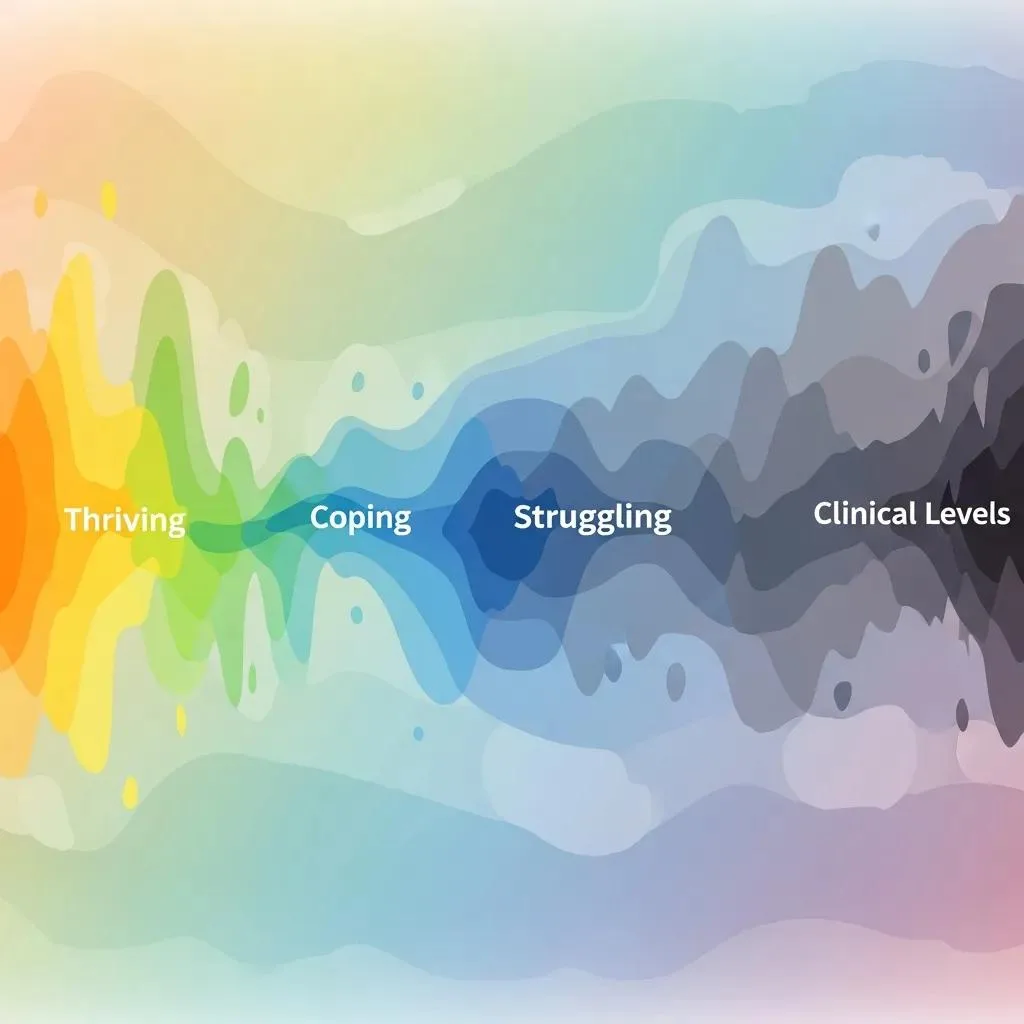
The mental health continuum frames functioning from healthy (thriving) through reactive (temporary distress) to clinical (disorder requiring treatment), and it helps normalize fluctuations rather than treating mental states as binary. This model clarifies that early signs—sleep disruption, persistent worry, or withdrawal—often indicate movement toward the reactive zone, where self-care and early supports can reverse the trend. Applying the continuum encourages low-stigma responses and stepped care: self-help and community support for mild symptoms, psychotherapy and medication for clinical levels, and urgent intervention for crisis. Recognizing movement along the continuum enables earlier, less intensive interventions that reduce long-term disability and improve recovery odds.
What Are the Most Common Mental Health Disorders?
Common mental health disorders include depressive disorders, anxiety disorders, bipolar disorder, post-traumatic stress disorder (PTSD), and eating disorders; each presents distinct core symptoms and functional impacts. These conditions arise from interactions among genetic vulnerabilities, neurobiology, life stressors, and social determinants, producing predictable patterns of mood, thought, and behavior disruption. Understanding typical presentations and prevalence helps prioritize screening and access to care, while knowing common comorbidities—such as depression with anxiety or substance use—guides integrated treatment planning.
The table below offers a concise comparative reference to aid recognition and triage.
Different disorders show distinct core symptoms, usual age of onset, and common prevalence patterns useful for clinicians and informed readers.
This comparison highlights symptom clusters and typical pathways that support early recognition and appropriate referral.
What Are the Symptoms and Types of Depression?
Depression typically presents with persistent low mood, loss of interest or pleasure (anhedonia), significant changes in sleep or appetite, fatigue, and slowed thinking; severe cases include suicidal ideation. Subtypes include major depressive disorder (discrete episodes), persistent depressive disorder (chronic low-grade symptoms), seasonal affective disorder (seasonal pattern), and postpartum depression (onset after childbirth). The mechanism involves dysregulated neurotransmitters, stress-response systems, and psychosocial stressors interacting to reduce motivation and cognitive function. When symptoms include thoughts of self-harm, severe functional decline, or psychotic features, immediate professional evaluation is essential and crisis resources should be used.
How Do Anxiety Disorders Manifest and Differ?
Anxiety disorders share core features—excessive fear or worry and behavioral avoidance—but differ by triggers and physiological response patterns, such as panic attacks in panic disorder, performance-related fear in social anxiety, or pervasive worry in generalized anxiety disorder (GAD). Phobias are characterized by intense fear of specific objects or situations, producing avoidance and distress that impair functioning. First-line treatments commonly include cognitive behavioral therapy (CBT) and, when appropriate, medication that modulates anxiety-related neurotransmitters; self-help strategies like structured breathing and exposure-based practice support recovery. Recognizing specific anxiety subtypes enables targeted interventions that reduce avoidance and restore daily functioning.
How Can You Improve Your Mental Well-Being?
Improving mental well-being relies on evidence-based lifestyle habits, stress management skills, and strengthening social supports that together enhance psychological resilience and reduce symptom risk. Biological mechanisms include regulation of sleep, neuroplasticity promoted by exercise, and stress-hormone reduction through relaxation techniques; psychological mechanisms involve cognitive reframing and strengthening coping repertoires. Practical application focuses on small, trackable habits—consistent sleep schedules, regular moderate exercise, mindful practices, balanced nutrition, and intentional social connection—that cumulatively raise baseline well-being.
Core self-care options vary in mechanism and evidence, so combining multiple practices typically yields the largest benefits.
Combining these practices builds a resilient base that complements targeted therapies when needed and reduces progression along the mental health continuum.
What Self-Care Practices Support Mental Health?

Core self-care practices include sleep hygiene, physical activity, mindful presence, nutritious eating, and social connection; each targets specific physiological and psychological processes that support mood and cognition. Implement sleep hygiene by fixing a consistent sleep window, creating a dark cool environment, and limiting stimulants late in the day to promote restorative sleep and cognitive restoration. For exercise, aim for at least 150 minutes of moderate aerobic activity weekly plus strength sessions; movement increases endorphins, BDNF, and executive function. Mindfulness practices—short daily meditations or grounding exercises—reduce rumination and improve attention; pairing these with digital hygiene (screen limits) helps prevent cognitive overload and supports emotional regulation.
Which Stress Management and Resilience Techniques Are Effective?
Immediate stress relief techniques like diaphragmatic breathing (e.g., 4-7-8 pattern), grounding exercises, and progressive muscle relaxation blunt the acute sympathetic response and restore cognitive control. Cognitive strategies—reframing negative thoughts, using thought records, and behavioral activation—address maladaptive patterns that sustain anxiety and low mood. Long-term resilience grows from consistent routines, purpose-driven goals, skill-building (problem-solving, emotion regulation), and cultivating social capital; these habits strengthen coping mechanisms and reduce susceptibility to future stressors. Practicing both acute tools and longer-term resilience-building creates durable protection against relapse.
When and How Should You Seek Mental Health Support?
Seek professional support when symptoms persist, worsen, or significantly impair work, school, or relationships, or when risk signs like self-harm, suicidal ideation, severe agitation, or psychosis appear; early assessment improves outcomes. Providers range from counselors and psychologists who deliver psychotherapy to psychiatrists who can provide medication management; teletherapy and digital resources expand access but require evaluation of quality. The following provider comparison table summarizes scope, typical role, and what to expect to help readers choose an appropriate pathway. If imminent danger exists, emergency services or crisis hotlines should be used immediately.
Understanding provider roles and access options helps match symptom severity to the right level of care and supports timely referrals.
This comparison clarifies pathways: start with assessment by a licensed clinician for persistent impairment, combine therapy and medication as indicated, and use crisis resources for immediate safety concerns.
What Are the Signs You Need Professional Help?
Warning signs for professional assessment include persistent or worsening symptoms lasting weeks, marked functional decline at work or school, withdrawal from relationships, or inability to carry out daily tasks. Risk indicators requiring urgent evaluation include thoughts of self-harm or suicide, sudden behavioral changes, paranoia or psychosis, and severe agitation or intoxication; in such cases, immediate crisis intervention is warranted. If self-help, lifestyle changes, and social supports fail to reduce symptoms or if symptoms recur frequently, professional assessment helps identify evidence-based treatments and coordinate care. Taking early action increases the likelihood of rapid improvement and prevents long-term impairment.
What Types of Therapies and Professionals Are Available?
Common evidence-based therapies include cognitive behavioral therapy (CBT) for anxiety and depression, dialectical behavior therapy (DBT) for emotion regulation, and EMDR for trauma-related conditions; each targets different mechanisms such as cognitive patterns, emotion modulation, or memory processing. Psychiatrists provide diagnostic assessment and pharmacotherapy, psychologists and counselors deliver psychotherapy, and social workers often combine therapy with resource coordination; treatment duration and approach depend on diagnosis and goals. When choosing a provider, consider credentialing, modality fit, session frequency, and whether combined medication and psychotherapy is indicated for optimal outcomes.
How Does Mental Health Awareness Reduce Stigma and Promote Support?
Raising mental health awareness reduces stigma by reframing mental states as common, treatable health issues rather than personal failings, which increases help-seeking and fosters supportive environments. Stigma mechanisms include public stigma (negative stereotypes), self-stigma (internalized shame), and structural stigma (barriers to care), all of which decrease disclosure and delay treatment; awareness campaigns that use personal stories and fact-based education counteract these processes. Community and workplace programs that normalize conversations about mental health, provide training, and implement supportive policies lower barriers and improve earlier access to care. The subsections below quantify stigma impacts and offer practical communication and advocacy steps to promote change.
What Is the Impact of Stigma on Mental Health Help-Seeking?
Stigma reduces disclosure of symptoms, delays treatment, and contributes to poorer outcomes by increasing isolation and reducing access to social supports and services. Statistical analyses show consistent treatment gaps across populations, with many individuals never receiving care for diagnosable conditions due to stigma, cost, or structural barriers; these gaps exacerbate disability and economic burden. Beyond individual effects, stigma affects families and workplaces by reducing accommodation and support, which can perpetuate cycles of stress and deterioration. Addressing stigma requires combined strategies that include education, policy change, and visible role modeling of help-seeking behavior.
How Can Open Conversations and Advocacy Improve Mental Health?
Open conversations and advocacy improve mental health by normalizing help-seeking, increasing resource visibility, and influencing policy to expand access and equity in care. Practical communication tips include using empathetic language, asking open-ended questions, listening without judgment, and offering specific support options like accompanying someone to an appointment. Advocacy actions range from sharing vetted resources and supporting local trainings to encouraging workplace policies that provide mental health days and access to counseling. When individuals model vulnerability and practical support, communities shift norms toward earlier help-seeking and stronger collective resilience.
- Key Takeaways for Action: Recognize early signs, use self-care practices, and seek professional help when functioning declines.
- Immediate Steps: Practice breathing or grounding during acute stress, maintain sleep and exercise routines, and reach out to one trusted person for support.
- Sustained Change: Advocate for stigma-reducing policies and model open conversations to expand community support networks.
These actions move individuals and communities from awareness to measurable improvements in mental well-being and access to care.