


Anxiety Support Groups: How They Help and How to Join
Anxiety support groups bring people together to learn coping strategies, practice real‑world skills, and reduce loneliness through regular, structured meetings. This guide explains what those groups look like, how therapist‑led and peer‑led formats work, and the practical steps to join one — from intake and confidentiality to what typically happens in the first sessions. You’ll get clear descriptions of group types (peer‑led, clinician‑led, condition‑specific, and virtual), evidence‑based benefits like improved coping and exposure practice, and how group work fits into a broader outpatient plan that may include individual therapy, medication management, and family involvement. We also offer concrete tips for finding the right group, evaluating fit and safety, and gentle next steps if you want help connecting to services. Throughout, terms such as anxiety support groups, anxiety group therapy, social anxiety support, and virtual support groups for anxiety are used to help you compare options and make informed choices.
What Are Anxiety Support Groups and How Do They Work?
Anxiety support groups are regular, organized meetings where people with similar challenges share experiences, learn coping techniques, and practice social or exposure skills in a guided setting. Groups combine peer validation, facilitated discussion, and structured skills training so members get both emotional support and practical tools to manage symptoms. A facilitator — either a licensed clinician or a trained peer leader — runs check‑ins, leads brief teaching segments, oversees skills practice, and assigns simple homework to reinforce progress between sessions. Members often leave with concrete strategies and clear referral pathways if they need more intensive care. Knowing the main group formats can help you choose the right match before enrolling; the section below summarizes common types and their typical features.
Anxiety support groups use repeatable session elements that make progress measurable and transferable.
They generally operate through three core mechanisms:
- Peer support: Members validate each other’s experience and share practical, lived strategies.
- Facilitated skills training: A leader teaches evidence‑based techniques (CBT, exposure, relaxation) and guides practice.
- Resource linkage: Groups connect participants to individual therapy, medication management, or crisis resources when needed.
These elements reduce isolation, build coping skills, and create accountability that supports ongoing recovery.
Below is a concise comparison of common group formats to help you weigh options.
Different group formats vary by leadership, focus, and goals:
What Types of Anxiety Support Groups Are Available?
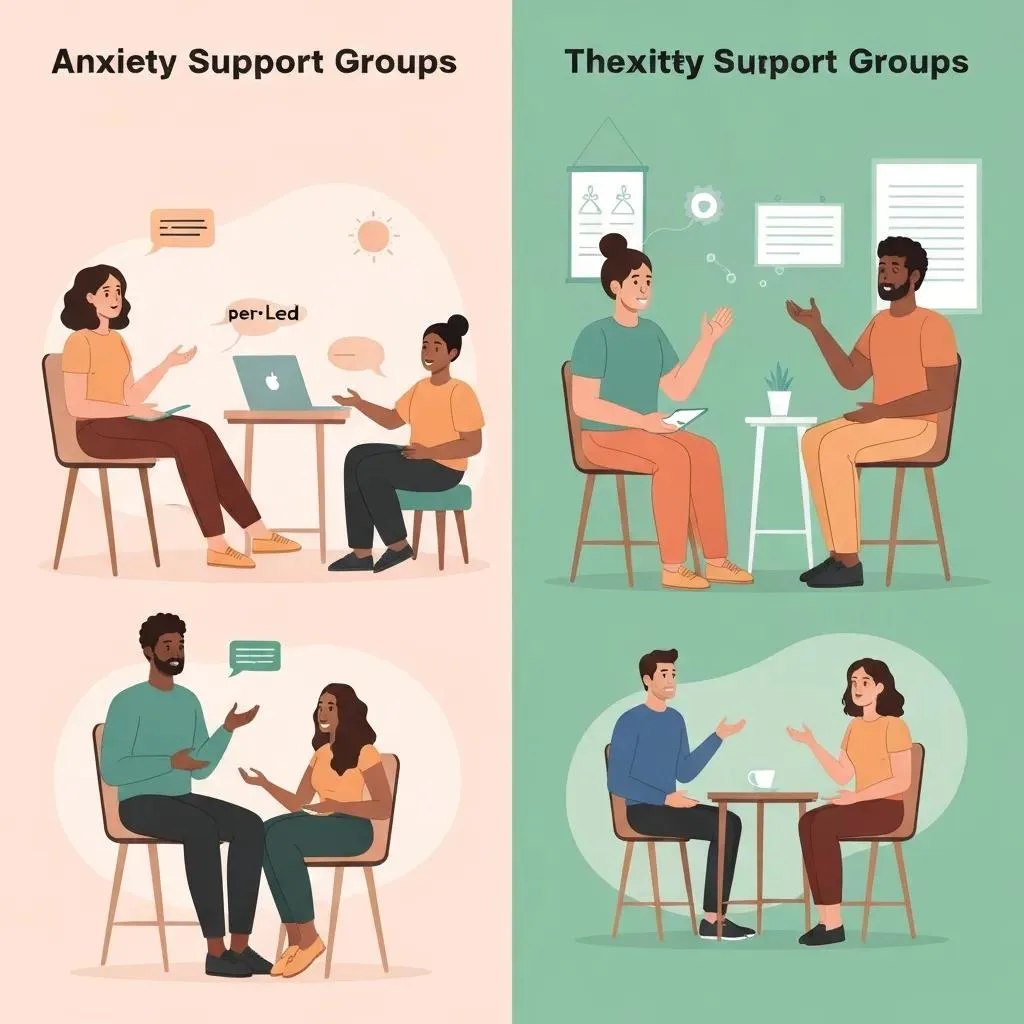
Support groups differ by who leads them, the clinical content they cover, and how they’re delivered — so choosing a group depends on whether you prioritize skill development, peer connection, or convenience. Peer‑led groups emphasize mutual support and lived experience, usually with flexible agendas and strong community bonds. Clinician‑led groups follow structured curricula grounded in evidence‑based methods like CBT and exposure, with measurable goals for symptom reduction. Condition‑specific groups focus on one diagnosis (for example, social anxiety, panic disorder, or generalized anxiety disorder) so members can practice targeted skills with peers who understand the same triggers. Groups may be offered in‑person, online, or as hybrids. When choosing, consider facilitator credentials, group size, and whether the program includes homework or coordination with individual care. Next we outline the main benefits people commonly gain from group participation.
What Are the Key Benefits of Joining an Anxiety Support Group?
Joining a support group delivers emotional, practical, and long‑term benefits that complement individual therapy and medication when used together. Emotionally, groups reduce loneliness and stigma by normalizing anxiety and offering repeated validation from people who know what it feels like. Practically, groups teach coping skills — cognitive restructuring, graded exposure, relaxation techniques — that members can rehearse safely and apply daily. Over time, many participants see improved social functioning, less avoidance, and clearer relapse‑prevention plans that make gains stick. These benefits are stronger when group work is coordinated with family education and medication management, helping translate session learning into lasting life changes.
Common benefits include:
- Reduced isolation: Shared experience lowers shame and normalizes symptoms.
- Skill acquisition: Evidence‑based techniques like CBT and exposure are taught and practiced.
- Maintenance and growth: Peer accountability, booster sessions, and alumni networks support long‑term recovery.
Together, these outcomes build a practical foundation for ongoing anxiety management and social reintegration.
How Does Emulate Treatment Center Approach Anxiety Support Groups?
At Emulate Treatment Center, group therapy is one part of a coordinated outpatient model that combines medical, psychological, and family‑centered services. Our pathway includes psychoeducation, clinician‑led therapy groups, medication management, and clear routes to higher levels of care — so group participation fits into a stepped‑care plan rather than standing alone.
In practice, Emulate pairs therapist‑led skills groups with peer supports and actively coordinates referrals among individual clinicians, prescribers, and family therapists to address dual diagnosis and co‑occurring substance‑use concerns. That coordination helps people move smoothly between levels of care and ensures group learning reinforces individual treatment goals. The table below maps core components and how they integrate with group programming.
What Is the Structure of Emulate’s Anxiety Group Therapy Programs?
Emulate’s groups follow a consistent structure designed for measurable learning: brief check‑ins, a focused psychoeducation segment (for example, CBT principles or exposure planning), guided practice or role‑play, and a wrap‑up with homework to reinforce skill generalization. Clinician facilitators align group topics with each member’s individualized goals and coordinate with prescribers when medication adjustments are needed. Group size and schedule vary, but the emphasis stays on skill acquisition, clinical oversight, and clear referral pathways when more intensive support is appropriate. Knowing this structure helps you understand what follows intake and how progress is tracked.
How Are Family Therapy and Dual Diagnosis Integrated with Anxiety Support?
Emulate coordinates family therapy and dual‑diagnosis care with group progress and individual goals. Family sessions cover how anxiety works, communication strategies, and relapse‑prevention planning to help family members support recovery without enabling avoidance. For dual diagnosis, screening guides a combined treatment plan that addresses both substance use and anxiety through integrated behavioral strategies, medication management, and targeted group modules that acknowledge overlapping triggers. Care coordinators ensure referrals between group therapy, individual counseling, and medication services are seamless so participants and families receive consistent, collaborative care. This integrated pathway reduces gaps and supports sustained recovery across settings.
Who Can Benefit from Anxiety Peer Support and Group Therapy?
Peer support and group therapy suit many adults seeking symptom relief, better daily functioning, and renewed social connection through shared learning and practice. People with generalized anxiety disorder (GAD), social anxiety, panic disorder, and many with co‑occurring depression often benefit because groups target avoidance, unhelpful thinking, and interpersonal skills.
Groups can also help family members and caregivers by offering education and strategies for supportive boundaries. That said, individuals in acute crisis, those with unmanaged severe psychiatric symptoms, or anyone needing immediate medical detox should receive higher‑intensity care first; group work is most effective when safety and stabilization needs are addressed.
Which Anxiety Disorders Are Commonly Supported in Groups?
Groups frequently support generalized anxiety disorder (GAD), social anxiety disorder, and panic disorder using targeted curricula and exposure‑based practice to reduce avoidance and improve daily functioning.
For social anxiety, groups provide safe chances for graded social exposure, role play, and constructive feedback — essential steps for behavior change. Panic‑focused groups use interoceptive exposure and CBT to reduce catastrophic interpretations of bodily sensations. Condition‑specific groups let participants practice precise skills with peers who share similar triggers, speeding learning and normalization. If symptoms are severe or safety is a concern, individual therapy or higher‑level care should come first to ensure readiness for group work.
How Do Support Groups Help Adults and Family Members Manage Anxiety?
Support groups help through education, modeling, and structured practice that translate clinical ideas into everyday routines and family interactions. Participants learn strategies such as cognitive reframing, graded exposure, and relaxation techniques while receiving feedback and seeing peers apply the same skills. Family members gain communication tools, boundary‑setting skills, and relapse‑prevention plans that reduce accommodation and support recovery. Practical outcomes include clearer action plans for anxiety episodes, more stable household routines, and shared problem‑solving that lowers caregiver burnout. These changes strengthen individual coping and family systems, helping recovery last.
What Should You Expect When Joining an Anxiety Support Group?
You can expect a brief intake and screening, an orientation to group norms, and early sessions focused on safety and rapport followed by gradual skill‑building over several weeks. Intake usually includes a clinical assessment to confirm group suitability, a discussion of personal goals, and a review of confidentiality and expectations. Early sessions prioritize trust, introduce baseline skills, and clarify homework commitments. Throughout participation, facilitators monitor progress, manage risk, and connect members to individual therapy or medication management when appropriate. The steps below lay out a typical pathway from intake to ongoing sessions.
Here’s a straightforward guide to what new members often experience:
- Initial intake: A clinical assessment to confirm suitability and goals.
- Orientation: Review of group rules, confidentiality, and expectations.
- First sessions: Rapport building, baseline skills, and collaborative goal‑setting.
- Ongoing participation: Regular skills practice, homework, and progress reviews.
These steps help ensure clarity, safety, and steady, measurable progress as you join regular meetings.
Intake components vary by program but generally screen for suitability and safety.
How Is Privacy and Safety Ensured in Anxiety Support Groups?
Privacy and safety start with a clear confidentiality agreement, facilitator training, and defined crisis protocols introduced at orientation and reinforced each session. Members agree to keep what’s shared in group confidential while understanding legal exceptions (such as imminent harm or mandatory reporting); facilitators explain these limits and document consent to participate.
Clinicians are trained to spot and escalate safety concerns, maintain professional boundaries, and coordinate with emergency or higher‑level care when necessary. Groups also set norms for respectful feedback, monitor group dynamics, and use individual risk assessments to guide continued suitability. These practices create a predictable, supportive environment where participants can engage in vulnerability with safety in mind.
What Are Typical Group Therapy Techniques Used for Anxiety Management?
Groups use a range of evidence‑based techniques — most commonly CBT skills, exposure exercises, mindfulness, and psychoeducation — adapted for group learning and practice. In group CBT, participants use cognitive restructuring, behavioral experiments, and thought records tied to shared themes. Exposure tasks are graded and practiced via role‑play or homework, with in‑session review and peer feedback to reinforce habituation. Mindfulness and relaxation exercises give immediate tools for regulating anxiety and are taught as daily practices to lower physiological arousal. These techniques are selected for their strong evidence base and flexibility in group settings, allowing members to learn and support one another’s progress.
How Can You Find and Access Online and In-Person Anxiety Support Groups?

Finding a suitable group usually means checking provider directories, local treatment centers, and national organizations, and then weighing fit and safety. Virtual groups expand access and can offer anonymity, while in‑person groups provide richer nonverbal cues and deeper social practice helpful for social anxiety. When evaluating options, look for facilitator credentials, a clear curriculum, confidentiality policies, and crisis procedures. The comparison below can help you choose the format that best fits your needs and constraints.
Common ways to find groups include:
- Treatment centers and community mental health clinics that run clinician‑led groups.
- National organizations and online directories that list peer and professional groups.
- Telehealth platforms and virtual meetup groups for remote access.
What Are the Differences Between Online Anxiety Support and In-Person Groups?
Online groups offer accessibility, scheduling flexibility, and often greater anonymity — a good option for remote or mobility‑limited participants. In‑person groups provide richer nonverbal feedback, stronger interpersonal bonding, and more realistic exposure opportunities, which can be especially helpful for social anxiety. Virtual settings may limit some hands‑on techniques, while in‑person meetings better facilitate certain behavioral practices. Hybrid models combine convenience with occasional in‑person sessions to balance these strengths. When choosing, confirm that online platforms use secure video tools and clear privacy protections.
Where Can You Find Emulate Treatment Center’s Anxiety Support Services?
If you’re looking for an integrated outpatient pathway that combines group therapy with medication management and family support, Emulate Treatment Center offers structured programs. Emulate provides outpatient services for substance use and co‑occurring mental health conditions, including anxiety, using a model that blends psychoeducation, evidence‑based therapies, medication management, and family therapy when appropriate. To request information or an intake assessment, contact Emulate through the online inquiry form or request an intake evaluation. The team will let you know what information to have ready and outline expected timelines for assessment and enrollment, helping make first steps less uncertain.
What Are the Long-Term Benefits and Recovery Outcomes of Anxiety Support Groups?
Over the long term, participation in anxiety support groups can reduce loneliness, improve coping skills, and lower relapse risk — especially when groups are part of a coordinated outpatient plan with booster sessions or alumni supports. Peer networks sustain motivation after intensive treatment, while practiced skills (CBT techniques, exposure hierarchies, relaxation) translate into better functioning at work and in relationships. When group work is combined with medication management and family therapy, outcomes usually improve because symptom reduction is supported both biologically and socially.
The section below explains how peer support and group therapy work to reduce isolation and symptom severity.
How Do Peer Support and Group Therapy Reduce Anxiety and Isolation?
Peer support reduces isolation by normalizing experiences and offering real examples of coping, while group therapy lowers anxiety through social learning, exposure practice, and mutual reinforcement of adaptive behaviors. Watching peers face triggers and apply skills gives a practical template for change and weakens catastrophic beliefs about social evaluation. Group accountability promotes homework completion and gradual risk‑taking, speeding habituation to feared situations. Together, these processes reduce avoidance and build confidence — key predictors of sustained improvement and community reintegration.
What Role Do Support Groups Play in Ongoing Anxiety Management and Relapse Prevention?
Support groups act as maintenance platforms — through booster sessions, alumni networks, or peer‑led communities — that help members monitor triggers, practice coping skills, and update relapse‑prevention plans over time. Regular check‑ins or periodic booster modules reinforce learning, spot early warning signs, and trigger timely adjustments to medication or therapy if needed. Connecting group membership to community resources and digital supports extends protection beyond clinic walls and helps preserve gains during life transitions. If you want help connecting to these pathways, a low‑pressure next step is requesting an intake assessment or information from an integrated outpatient provider that can coordinate group enrollment and follow‑up care.
Frequently Asked Questions
1. How do I know if an anxiety support group is right for me?
Deciding whether a group is right for you depends on your current symptoms, personal goals, and comfort level with sharing in a group. Think about the severity of your anxiety, whether you’d benefit from peer connection or structured clinical skills, and whether you’re ready to take part in group exercises and homework. If you’re unsure or in crisis, consult a mental health professional who can recommend the safest and most effective next step.
2. What should I prepare before attending my first anxiety support group session?
Before your first session, reflect on why you want to join and what you hope to gain. Review any orientation materials, note questions for the facilitator, and be ready to share a little about your goals. Coming in with an open, curious attitude — not pressure to perform — will help you get more out of the experience.
3. Can family members join anxiety support groups?
Some groups are designed specifically for family members or caregivers, while others focus on people with anxiety. Family sessions typically teach communication strategies, boundary‑setting, and ways to support recovery without enabling avoidance. If you’re a family member, ask providers about family‑focused groups or available family therapy that complements the individual’s treatment.
4. How can I evaluate the effectiveness of an anxiety support group?
Evaluate effectiveness by tracking personal change over several sessions: do you feel less alone, have you learned useful coping tools, and can you apply techniques outside group? Also consider group dynamics, facilitator competence, and whether the environment feels safe and respectful. If your needs aren’t being met, it’s reasonable to look for a different group or additional individual support.
5. Are there any costs associated with joining an anxiety support group?
Costs vary. Peer‑led groups are often free or low‑cost, while clinician‑led groups may charge fees that could be covered by insurance. Ask about session fees, sliding‑scale options, and insurance coverage during intake so you know what to expect financially.
6. What happens if I feel uncomfortable during a session?
If you feel uncomfortable, tell the facilitator — either during the session or privately afterward. Facilitators are trained to manage difficult moments and adjust group dynamics to keep the space safe. It’s okay to take a break or step back while you process; your comfort and safety are a priority.
7. How can I find a support group that fits my specific anxiety needs?
Search local mental health organizations, treatment centers, and reputable online directories for groups that match your diagnosis and preferences (peer vs. clinician led, in‑person vs. virtual). Ask your clinician for recommendations based on your treatment goals, and confirm facilitator credentials, confidentiality practices, and crisis protocols before joining.
Conclusion
Anxiety support groups offer practical tools and real human connection that reduce isolation and strengthen long‑term coping. When combined with individual therapy, medication management, and family support, groups become a powerful part of recovery. If you’re ready to explore options, reach out to a trusted provider or request an intake assessment to find a group that fits your needs and goals — the next step can be small, and it can make a meaningful difference.