


Share This Guide on OCD Symptoms & Treatment
Obsessive-Compulsive Disorder (OCD) is a mental health condition defined by persistent obsessions—intrusive, unwanted thoughts—and compulsions—repetitive behaviors or mental acts performed to reduce distress. This guide explains how obsessions and compulsions interact to produce significant anxiety and functional impairment, and it outlines the latest approaches to diagnosis, evidence-based treatment, and daily management. Readers will learn to recognize core OCD symptoms, distinguish common subtypes such as contamination and checking OCD, understand current models of causes including genetic and neurobiological contributors, and evaluate effective treatments like cognitive behavioral therapy with exposure and response prevention (ERP) and SSRI medication. The article also covers advanced treatments for treatment-resistant cases and offers practical coping strategies for living with OCD, emphasizing the role of support systems and structured self-care. Throughout, keywords such as ocd symptoms, compulsive behaviors, exposure and response prevention, cbt for ocd, ssris for ocd, and living with ocd are integrated to help readers seeking clinical information and actionable steps. This resource aims to be a balanced, up-to-date primer for adults with OCD, caregivers, and clinicians seeking a clear roadmap for understanding and managing the condition.
What Are the Core Symptoms of Obsessive-Compulsive Disorder?
Obsessive-Compulsive Disorder centers on two core symptom domains: obsessions and compulsions, each producing predictable psychological and behavioral consequences. Obsessions are unwanted, intrusive thoughts, images, or urges that create marked anxiety, while compulsions are repetitive behaviors or mental acts performed to reduce that anxiety; together they form a cycle in which rituals temporarily relieve distress but reinforce future obsessions. Recognizing these domains helps clinicians and individuals identify when normal worries escalate into clinically significant OCD that interferes with work, relationships, or daily routines. Understanding the anxiety-relief cycle clarifies why treatments such as cognitive behavioral therapy and exposure and response prevention target both the thought patterns and the ritual behaviors that sustain OCD. The next sections break down obsessions and compulsions with concrete examples and clinical impact.
What Are Obsessions and How Do They Affect Adults with OCD?
Obsessions are intrusive, persistent thoughts, images, or impulses that are experienced as distressing and often inconsistent with the person’s values, such as violent or sexual images or intense fears of contamination. These intrusive mental events trigger high anxiety, guilt, or shame and consume time through rumination, mental checking, or avoidance, which in turn disrupts concentration and daily functioning. For many adults, obsessions lead to avoidance of certain places or topics, strained relationships because of secrecy or embarrassment, and impaired occupational performance due to preoccupation. Clinically, obsessions are evaluated for content, frequency, and the level of distress they cause, which informs treatment planning and priority for exposure exercises. Recognizing obsessions as symptoms rather than personal character flaws is the first therapeutic step that supports engagement in evidence-based interventions.
What Are Compulsions and Examples of Repetitive Behaviors in OCD?
Compulsions are behavioral or mental acts performed in response to an obsession or according to rigid rules, intended to prevent feared outcomes or reduce distress, such as repeated handwashing, checking locks, counting rituals, or seeking reassurance. These actions provide short-term anxiety relief but function as negative reinforcement, making the obsessions more salient and the rituals more frequent over time. Compulsions can be overt—like ordering and arranging objects for symmetry—or covert, such as mental prayer, silent counting, or reviewing memories to neutralize distressing thoughts. Because compulsions often consume hours per day, they can lead to social withdrawal, work impairment, and family conflict, which makes reducing ritualized behaviors a key target in effective treatments like ERP. The next section explores common OCD subtypes and how their obsession-compulsion patterns differ.
Which Types of OCD Are Most Common and How Do They Differ?
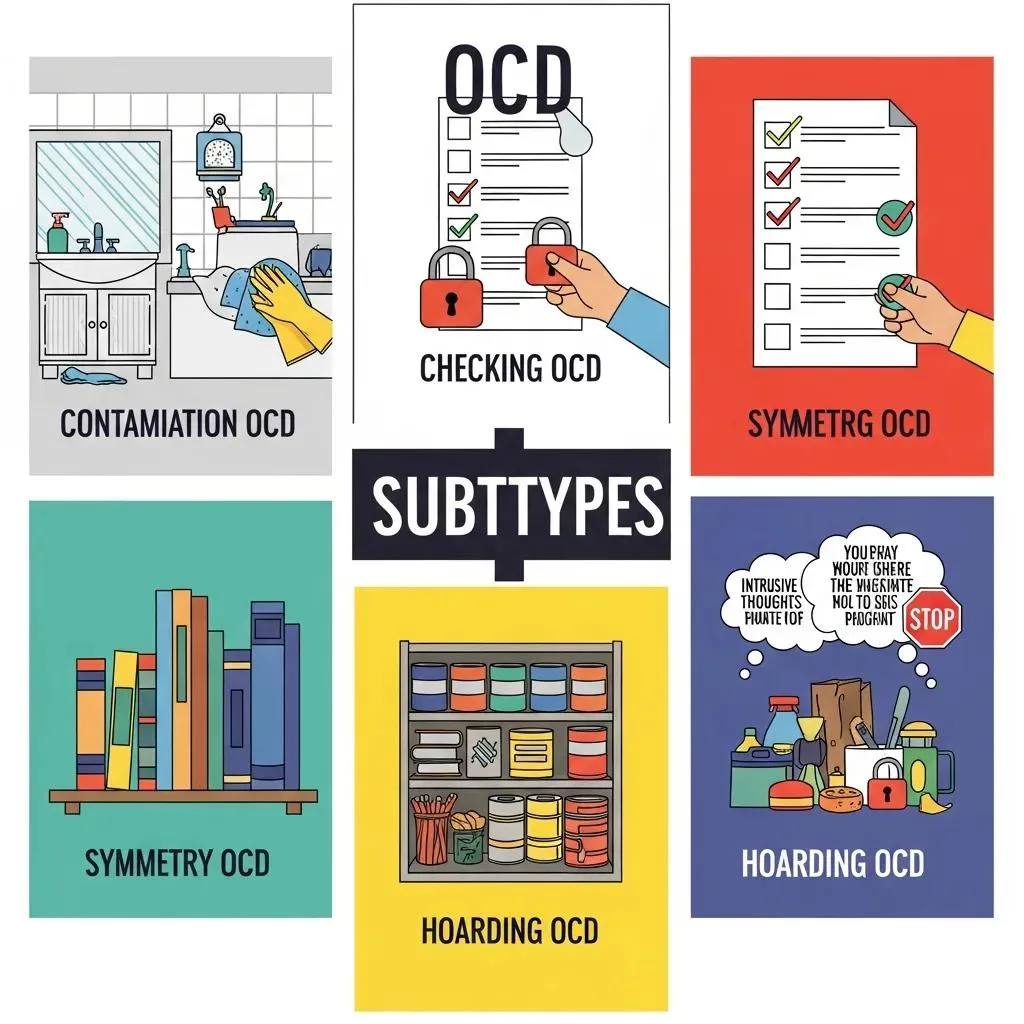
OCD presents in identifiable subtypes that share the same underlying anxiety-reinforcement dynamics but differ in content and typical compulsive responses, which aids diagnosis and tailored treatment planning. Common subtypes include Contamination OCD, Checking OCD, Symmetry and Order OCD, Intrusive Thoughts (often called “Pure O”), and Hoarding-related presentations; each subtype has characteristic obsessions and compulsions that clinicians use to design specific exposure hierarchies. Identifying subtype distinctions also informs the choice of ERP exercises—for example, contamination exposures differ from those used for symmetry or intrusive thoughts.
This table summarizes common OCD subtypes, their core obsessions, typical compulsions, and distinguishing clinical features.
This comparison clarifies how content and behavioral responses shape clinical presentation and choice of exposures; the following subsection examines contamination OCD in greater detail.
What Is Contamination OCD and Its Typical Symptoms?
Contamination OCD involves persistent fears about germs, toxins, or contaminating substances that lead to excessive cleaning, showering, or avoidance of perceived contaminants, and sometimes elaborate decontamination rituals. Severity ranges from mild heightened hygiene to housebound avoidance where even brief contact with perceived contaminants triggers prolonged washing or contacting others for reassurance, which can impair daily functioning. Treatment typically emphasizes graded exposure to contamination cues paired with response prevention to reduce avoidance and ritualized washing while ensuring safety and medical reasonableness. Clinicians design exposures that start with low-feeling contamination tasks and progress to more challenging situations, which helps extinguish fear and rebuild confidence in tolerance of discomfort.
How Do Checking, Symmetry, Intrusive Thoughts, and Hoarding OCD Manifest?
Checking OCD is characterized by repeated verification driven by doubt—checking locks, appliances, or work—aimed at preventing feared harm but maintained by uncertainty intolerance. Symmetry and order OCD involves arranging, ordering, or repeating actions until they “feel right,” often consuming large amounts of time and interfering with routines. Intrusive Thoughts or “Pure O” feature distressing mental obsessions—violent, sexual, or blasphemous content—accompanied by mental rituals like neutralizing thoughts or seeking reassurance. Hoarding-related presentations involve excessive collection and difficulty discarding items, often tied to strong emotional attachments or fear of needing items later; when hoarding stems mainly from indecisiveness and accumulation without classic obsessions, differential diagnosis for hoarding disorder is considered. Understanding these manifestations informs targeted ERP exposures and cognitive strategies tailored to each presentation.
What Causes Obsessive-Compulsive Disorder and What Are the Risk Factors?
OCD arises from an interaction of genetic vulnerability, atypical brain circuit functioning, and environmental triggers that together increase risk and shape symptom expression. Genetic studies and family aggregation research indicate heritable components that raise susceptibility without determinism, while neurobiological models implicate cortico-striato-thalamo-cortical circuits and neurotransmitter systems—particularly serotonin and emerging glutamate pathways—in producing repetitive thoughts and behaviors. Environmental risk modifiers include childhood adversity, stressful life events, and, in some pediatric cases, post-infectious processes such as PANDAS; these factors can precipitate onset or exacerbate symptoms in genetically predisposed individuals.
Key risk factors for OCD and their supporting evidence are summarized below.
This overview highlights that OCD is multifactorial: biological predispositions interact with external stressors to produce the clinical syndrome. The next subsections examine genetics and brain biology, then environmental triggers in more detail.
How Do Genetics and Brain Biology Contribute to OCD?
Genetic research shows that OCD runs in families and that specific genetic variations increase susceptibility, indicating heredity contributes to risk but does not guarantee development of OCD. Neuroimaging and neurophysiological studies implicate dysfunction in cortico-striato-thalamo-cortical circuits—networks linking frontal cortex and basal ganglia—that regulate habits, error detection, and inhibitory control, which helps explain repetitive behaviors and intrusive thoughts. Neurotransmitter research supports a role for serotonin in modulating anxiety and compulsivity, as evidenced by SSRI efficacy, while glutamate findings have emerged as a promising avenue for understanding compulsive circuitry and developing new treatments. Together, genetics and brain biology provide mechanistic targets for both pharmacotherapy and neuromodulation strategies aimed at normalizing circuit activity. Considering these mechanisms leads into the role of environmental triggers that can precipitate or worsen symptoms.
What Environmental Factors and Life Events Increase OCD Risk?
Environmental influences such as childhood trauma, chronic stress, significant life transitions, and certain infections can precipitate OCD onset or exacerbate existing symptoms by interacting with biological vulnerability. Examples include traumatic experiences that increase anxiety sensitivity, high-stress periods that amplify rigid control behaviors, and rare pediatric autoimmune responses (PANDAS) linked to sudden symptom emergence after infection. These factors are best described as risk modifiers—associated with increased likelihood or severity rather than deterministic causes—and they help explain variability in onset age and symptom trajectories. Clinically, assessing recent life events and stressors is essential to formulating an integrated treatment plan that addresses both biological and psychosocial contributors. Understanding triggers informs the development of tailored exposures and relapse-prevention strategies.
What Are the Effective Treatment Options for OCD?

Evidence-based treatment for OCD centers on cognitive behavioral therapy with exposure and response prevention (ERP) and pharmacotherapy with SSRIs or clomipramine, while advanced neuromodulation and emerging agents are options for treatment-resistant cases. CBT with ERP directly targets the obsession-compulsion cycle through graduated exposures to feared stimuli while preventing ritualized responses, producing durable symptom reduction for many patients. SSRIs and the tricyclic clomipramine modulate serotonergic systems and are effective for numerous individuals, often used alone or in combination with CBT; augmentation strategies may be considered when monotherapy yields partial response. For severe, treatment-resistant OCD, options such as transcranial magnetic stimulation (TMS), deep brain stimulation (DBS), and experimental pharmacologic approaches have evidence of benefit in carefully selected cases.
The comparison table below outlines major OCD treatments, their mechanisms, typical efficacy, time to effect, common side effects, and suitable severity levels.
This clinical comparison helps clinicians and patients weigh options based on severity, side-effect profiles, and treatment goals; the next subsections describe CBT/ERP, medications, and advanced therapies in practical terms.
How Does Cognitive Behavioral Therapy and Exposure and Response Prevention Work?
CBT for OCD focuses on identifying and modifying maladaptive beliefs and behaviors that maintain obsessive-compulsive cycles, with ERP as the behavioral core that systematically exposes individuals to feared stimuli while preventing ritual responses. ERP uses a collaborative exposure hierarchy that begins with lower-anxiety tasks and progresses to more challenging exposures, allowing habituation and new learning that fear will subside without rituals; therapist guidance and repeated practice are essential for durable change. Typical courses involve weekly sessions over several months with between-session homework exposures; many patients experience meaningful symptom reduction within weeks, with maximal gains accruing over months. Common challenges include initial anxiety spikes, avoidance of homework, and family accommodation, all of which are addressed via psychoeducation, motivational strategies, and family involvement to support response prevention. Effective ERP integrates cognitive techniques to challenge unhelpful beliefs about responsibility, perfectionism, and intolerance of uncertainty.
What Medications Are Used for OCD and What Are Their Effects?
First-line pharmacotherapy for OCD consists of selective serotonin reuptake inhibitors (SSRIs) such as fluoxetine, sertraline, fluvoxamine, paroxetine, and escitalopram, which reduce symptom severity for many patients by modulating serotonergic circuits involved in anxiety and compulsion. Clomipramine, a tricyclic antidepressant with strong serotonergic effects, is an alternative when SSRIs are ineffective but carries a different side-effect profile that requires medical monitoring. Medication onset is typically measured in weeks, with clinicians often waiting 8–12 weeks to assess full therapeutic benefit and adjusting doses under supervision; augmentation with other agents or combined CBT is considered for partial responders. Common side effects include gastrointestinal upset, sleep disturbances, and sexual dysfunction; medical follow-up addresses tolerability and safety. Understanding the balance of efficacy and side effects helps patients and clinicians select appropriate medication strategies and plan monitoring.
What Advanced Treatments Exist for Severe or Resistant OCD?
For severe or treatment-resistant OCD, clinicians may consider neuromodulation techniques such as transcranial magnetic stimulation (TMS), invasive options like deep brain stimulation (DBS), or emerging pharmacologic interventions with rapid-acting profiles for acute symptom relief. TMS is non-invasive and targets cortical regions to modulate network activity with accumulating evidence of benefit in resistant cases, while DBS involves stereotactic implantation to target subcortical circuits and is reserved for carefully selected, refractory patients due to surgical risks. Experimental agents and novel delivery approaches—some supported by recent trials—offer promise for rapid symptom reduction but often have limited durability and require further research; these approaches are typically considered after evidence-based psychotherapy and medication trials have been exhausted. In all cases, multidisciplinary evaluation and informed consent are essential because advanced treatments balance potential benefits against risks, invasiveness, and long-term management considerations.
How Can Individuals Live with OCD and Manage Symptoms Daily?
Living with OCD involves combining evidence-based therapy, medication when indicated, structured self-care, and supportive systems that reduce accommodation while promoting independence in managing symptoms. Practical strategies—such as scheduled exposure practice, mindfulness for tolerating distress, sleep and exercise routines, and planning to reduce stress—complement formal treatment and enhance resilience. Family involvement that avoids enabling rituals while supporting ERP homework can accelerate progress, and peer support or structured groups provide social validation and skills practice for many individuals. Below are actionable coping strategies and a checklist to guide daily management and prioritization of interventions for symptom control and quality-of-life improvement.
- Scheduled Exposures: Practice brief, repeated ERP exercises daily to build tolerance and reduce avoidance.
- Mindfulness & Distress Tolerance: Use mindfulness skills to observe intrusive thoughts without acting on them.
- Lifestyle Routines: Prioritize sleep, regular exercise, and balanced nutrition to stabilize mood and reduce reactivity.
- Structured Planning: Break tasks into small steps and set limits on ritual time to reclaim daily activities.
These steps provide a foundation for symptom management; the next subsection offers more detailed coping practices.
What Coping Strategies and Self-Care Practices Help Manage OCD?
Daily self-care practices that support OCD treatment include mindfulness meditation to change the relationship to intrusive thoughts, brief scheduled exposures to reduce avoidance, and consistent sleep and exercise routines to lower baseline anxiety. Practicing ERP homework in small, manageable steps prevents overwhelm and builds confidence, while using objective progress tracking—such as brief logs of exposure success—reinforces change and guides therapy adjustments. Stress-management techniques like paced breathing and activity scheduling decrease emotional reactivity, making it easier to tolerate triggers without resorting to compulsions. When combined with professional treatment, these self-care strategies improve functioning and reduce the likelihood of relapse by strengthening psychological flexibility and behavioral control.
How Can Support Systems and Family Help Those with OCD?
Family and support systems play a pivotal role by encouraging treatment engagement, supporting ERP homework, and avoiding behaviors that inadvertently accommodate compulsions, such as providing reassurance or performing rituals on behalf of the person with OCD. Practical guidance for families includes scripts for refusing reassurance kindly, setting boundaries around accommodation, and participating in family-based therapy sessions to learn supportive responses and communication strategies. Encouraging independence in problem-solving, praising attempts at exposures, and coordinating with clinicians for consistent messaging helps create an environment that reinforces therapeutic gains. When family members understand OCD mechanisms and collaborate with therapists, outcomes improve because treatment consistency and reduced accommodation directly weaken the obsession-compulsion cycle.