


CBT vs DBT: Comprehensive Comparison of Cognitive and Dialectical Therapies for Mental Health
Cognitive Behavioral Therapy (CBT) and Dialectical Behavior Therapy (DBT) are structured, evidence-based psychotherapies that help people change unhelpful patterns—CBT by targeting distorted thoughts and behaviors, DBT by combining acceptance strategies with skills for emotional regulation. Both use therapist-guided interventions and homework to produce measurable symptom reduction, but they differ in emphasis, format, and target populations. This article explains what each therapy is, their historical origins, core mechanisms, and the practical techniques clinicians and patients use in treatment. Readers will learn how CBT conceptualizes the links between thoughts, feelings, and behaviors, how DBT organizes skills training around a dialectic of acceptance and change, and where the therapies overlap and diverge. The guide also provides evidence summaries, comparison tables, decision guidance for choosing between CBT and DBT, and examples of when integration is appropriate. By the end you will have a clear, clinically useful map of CBT vs DBT to discuss with a clinician or to inform care decisions.
What is Cognitive Behavioral Therapy? Definition, History, and Core Principles
Cognitive Behavioral Therapy (CBT) is a time-limited, goal-oriented psychotherapy that focuses on identifying and changing maladaptive thoughts and behaviors to reduce distress and improve functioning. Developed by Aaron Beck in the 1960s, CBT rests on the principle that cognitive distortions shape emotional responses and behavioral choices, and that structured interventions can modify these patterns to produce symptom relief. Typical CBT aims include symptom reduction, behavioral activation, and relapse prevention through skills like cognitive restructuring and exposure, and sessions often emphasize measurable goals and homework practice. Understanding CBT’s core model prepares clinicians and patients to apply specific techniques that target the cognitive–emotional–behavioral cycle, which the next subsection will describe in practical terms.
How does CBT address thoughts, feelings, and behaviors?
CBT addresses the interplay between thoughts, feelings, and behaviors by helping clients identify automatic thoughts, test their accuracy, and design behavioral experiments to gather disconfirming evidence. Clinicians use tools such as thought records to capture situations, automatic thoughts, emotional intensity, evidence for and against beliefs, and alternative balanced thoughts, which then inform behavioral experiments that test new predictions. For example, a patient with panic-related avoidance might record the catastrophic thought (“I’ll faint if I exercise”), test it with a graded exertion exercise, and update beliefs based on the outcome, thereby reducing avoidance and anxiety. This structured sequence—assessment, cognitive reappraisal, and behavioral activation—creates a feedback loop that alters emotion and behavior, and it naturally leads into discussion of common CBT techniques.
What are common CBT techniques like cognitive restructuring and exposure therapy?
CBT deploys several well-validated techniques tailored to presenting problems, including cognitive restructuring to challenge distortions, behavioral activation to combat depression, and graded exposure to reduce avoidance in anxiety disorders. Cognitive restructuring teaches clients to recognize cognitive distortions (e.g., catastrophizing, overgeneralization), evaluate evidence, and generate balanced alternatives; behavioral activation schedules value-driven activities to increase positive reinforcement and mood. Exposure therapy uses a hierarchy of feared stimuli and repeated, controlled exposure to extinguish conditioned responses—examples include in vivo exposure for phobias and imaginal exposure for trauma memories. These techniques are often combined and delivered with homework, and the next section examines DBT’s complementary approach to emotion-focused skill training.
What is Dialectical Behavior Therapy? Definition, History, and Key Modules
Dialectical Behavior Therapy (DBT) is a comprehensive cognitive-behavioral treatment developed by Marsha Linehan in the late 1980s that integrates behavioral change strategies with acceptance-based interventions to treat severe emotion dysregulation and self-harm. Originally designed for individuals with Borderline Personality Disorder (BPD) and chronic suicidal behavior, DBT blends individual therapy, skills training groups, and phone coaching to promote skills acquisition and apply them in real-world crises. The therapy centers on a dialectic—balancing acceptance (validation, mindfulness) with change (skills training, behavioral targets)—and organizes teaching around four core modules: mindfulness, emotion regulation, distress tolerance, and interpersonal effectiveness. Understanding these modules and DBT’s team-based structure clarifies how DBT addresses crises and chronic dysregulation, which the next subsection will break down into module-specific skills and exercises.
What are the four DBT skill modules: mindfulness, emotion regulation, distress tolerance, and interpersonal effectiveness?
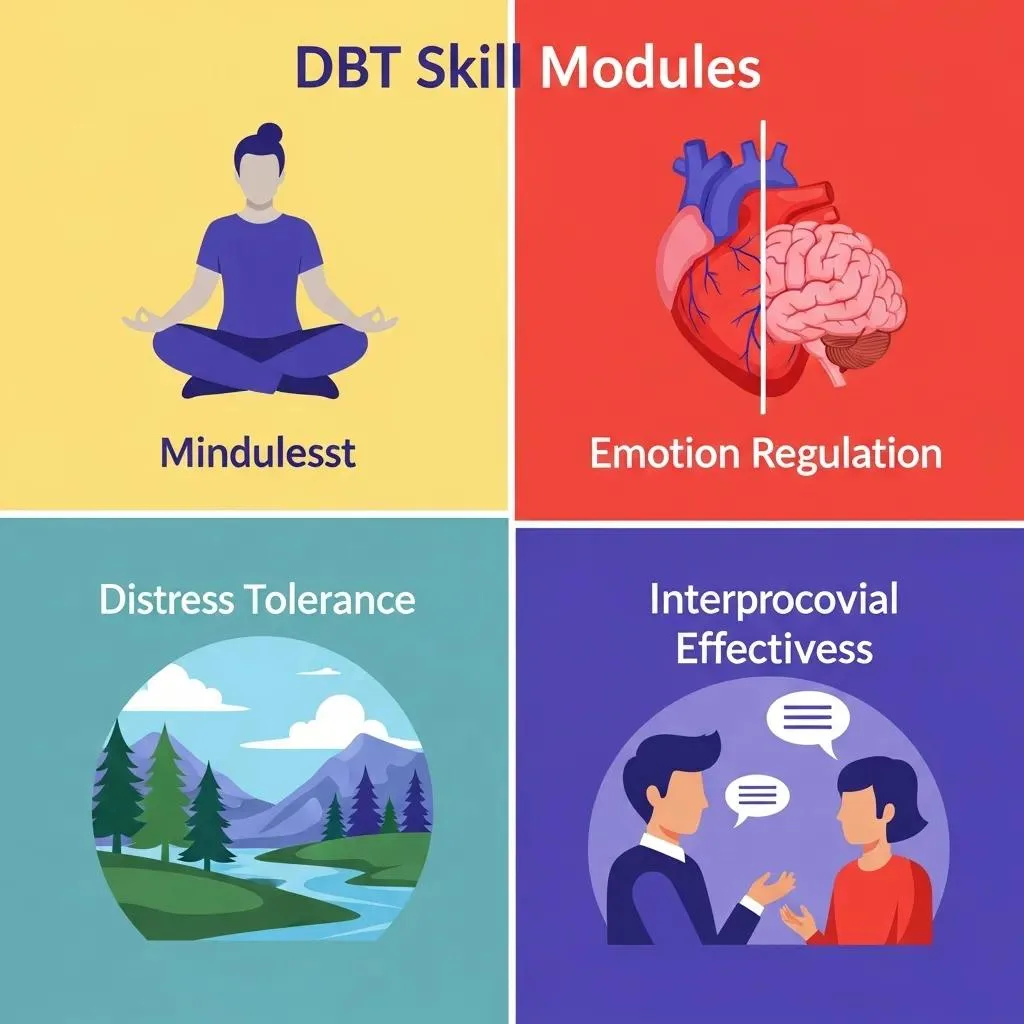
DBT’s four modules each teach a cluster of practical skills to improve moment-to-moment functioning and reduce maladaptive coping patterns. Mindfulness trains observing and describing internal experience without judgment; emotion regulation teaches identifying emotions, reducing vulnerability, and using opposite action; distress tolerance provides crisis survival skills like self-soothing and TIP (temperature, intense exercise, paced breathing); interpersonal effectiveness offers strategies such as DEAR MAN to assert needs while maintaining relationships. The table below summarizes each module with core skills and an example exercise to practice.
How does DBT integrate acceptance and change in therapy?
DBT integrates acceptance and change by using validation and mindfulness to foster safety and therapeutic alliance while simultaneously teaching skills that produce behavioral change and target problem behaviors. Therapists validate a client’s experience to reduce shame and defensiveness, then collaboratively set behavioral targets and coach skills implementation—this dialectic reduces resistance and enhances motivation for change. For instance, a clinician may validate a client’s overwhelming urge to self-harm while also teaching distress-tolerance strategies and a safety plan, thereby balancing compassion with active behavioral intervention. This combined stance—valuing acceptance and promoting change—creates a stable platform from which skill generalization and symptom reduction can occur, and it also highlights areas where CBT and DBT overlap, which we explore next.
What are the Key Similarities Between CBT and DBT?
CBT and DBT share several foundational features: both are evidence-based psychotherapies, they emphasize skills training and homework, and they are present-focused and structured toward measurable goals. Each approach uses behavioral principles—such as exposure and reinforcement—and both incorporate cognitive strategies to some degree: CBT focuses explicitly on cognitive restructuring, while DBT includes mindfulness and cognitive change techniques within skills training. Empirical support underpins both therapies across a range of conditions, and both prioritize therapist-guided practice and outcome monitoring to track progress. These shared foundations make it straightforward for clinicians to adapt elements from one model to another when appropriate, and the next subsection details common methodological features they rely on.
How do CBT and DBT share foundations in talk therapy and skill-building?
Both CBT and DBT rely on a collaborative therapeutic relationship, structured sessions, homework assignments, and explicit skill rehearsal to translate gains from session to daily life. Therapists in either modality set clear agendas, use behavioral experiments or between-session practice, and monitor progress with rating scales or behavioral logs to maintain a goal-oriented focus. For example, homework in CBT might be a behavioral experiment testing a belief, while DBT homework could be practicing a distress tolerance skill during a stressful moment; both require guided review and troubleshooting in session. These shared methodologies support skill acquisition and generalization and naturally lead into evidence showing their efficacy across disorders, which the next subsection summarizes.
What evidence supports both therapies as effective treatments?
A growing body of meta-analyses and randomized controlled trials through 2023 supports CBT as a first-line treatment for anxiety disorders, depression, PTSD, and OCD, while DBT has the strongest evidence for reducing self-harm, suicidality, and improving outcomes in Borderline Personality Disorder. Recent systematic reviews indicate large effect sizes for CBT in anxiety and depressive disorders and robust reductions in symptom severity with structured CBT protocols; DBT trials consistently show reduced self-injury and improved emotion regulation in populations with severe dysregulation. Clinicians choose therapies based on disorder-specific evidence, individual presentation, and treatment goals, and understanding comparative efficacy helps guide those decisions in practice.
What are the Main Differences Between CBT and DBT in Focus and Application?
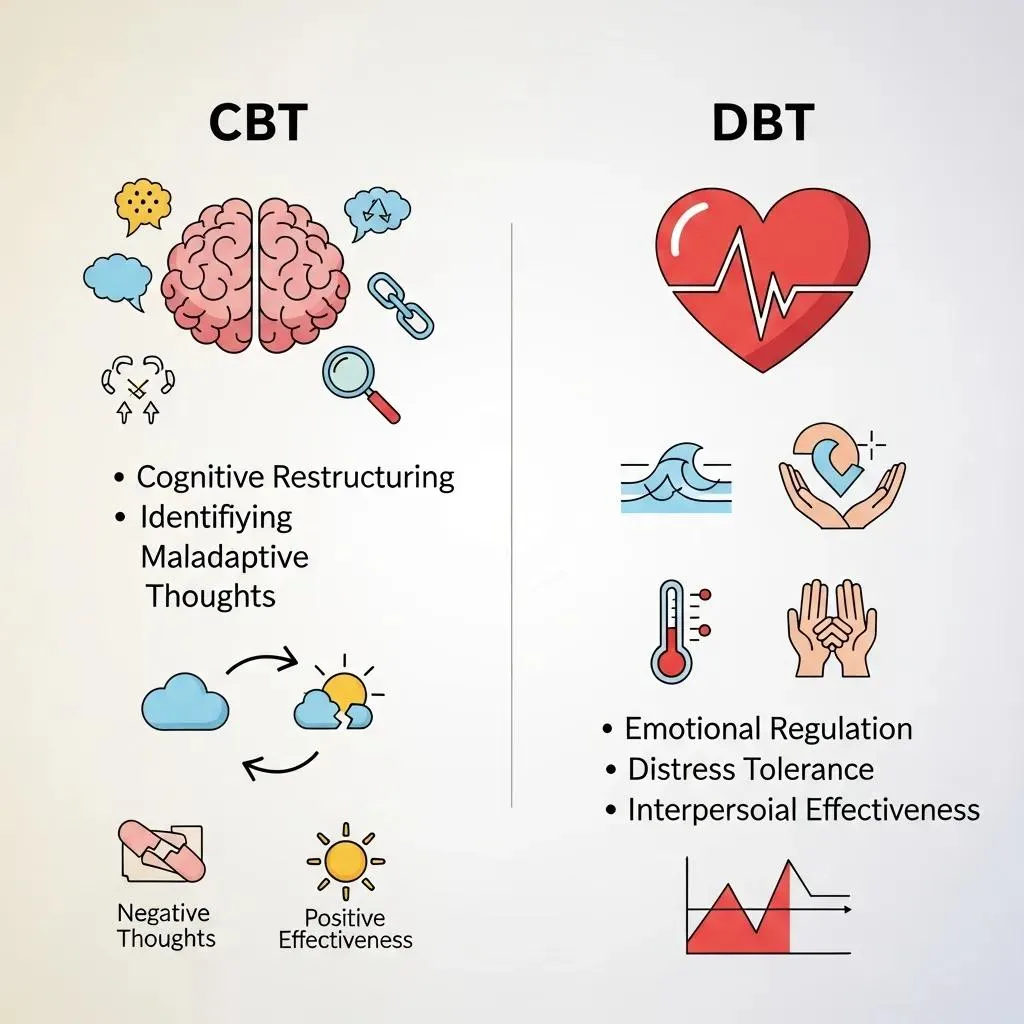
The main difference is conceptual emphasis: CBT directly targets maladaptive cognitions and behaviors to change emotional states, whereas DBT gives equal weight to acceptance and change, focusing on emotion regulation, crisis management, and interpersonal functioning for patients with high emotional vulnerability. Session formats diverge: CBT is commonly individual and short-term with homework-focused sessions, while DBT often combines individual therapy, group skills training, and phone coaching with a team consultation model. Treatment targets also differ—CBT is widely used for anxiety, depression, and phobias; DBT is specialized for complex emotion dysregulation and self-harm—though overlap exists. The table below systematically compares core attributes to clarify these distinctions for clinicians and patients.
How do CBT and DBT differ in primary focus: cognition and behavior versus emotional regulation and acceptance?
CBT emphasizes identifying cognitive distortions and conducting behavioral experiments to reduce avoidance and maladaptive behaviors, for example treating a social phobia by restructuring negative self-beliefs and using graded exposure to social situations. DBT prioritizes building skills to tolerate crises, regulate intense emotions, and maintain relationships—skills often crucial for patients prone to self-harm or impulsivity—using validation to reduce shame while teaching concrete strategies. Clinically, a person with panic disorder may benefit most from CBT exposure-based protocols, whereas someone with recurrent self-injury and rapid mood swings may need DBT’s multi-component skills-focused program. Recognizing these differing emphases helps clinicians choose or combine approaches based on presenting problems and treatment goals.
Which mental health conditions are best treated by CBT versus DBT?
The following table maps common conditions to the typical roles of CBT and DBT, clarifying where each therapy is commonly recommended and why. An accompanying summary explains overlap and clinical decision-making.
How to Choose Between CBT and DBT: Factors and Decision Guidance
Choosing between CBT and DBT should be driven by symptom profile, specific diagnoses, treatment goals, and practical factors such as therapist training and program availability. Start by assessing primary problems: phobic avoidance, panic, or intrusive trauma symptoms typically point to CBT; chronic self-harm, unstable relationships, or pervasive emotional dysregulation suggest DBT. Consider patient goals—symptom reduction via cognitive restructuring or skill-building for crisis management—and evaluate therapist expertise: DBT requires team consultation and skills-group infrastructure that not all clinics provide. These decision factors form a pragmatic checklist clinicians and patients can use when discussing treatment options, which the next subsection maps to symptom clusters.
What symptoms and diagnoses influence therapy selection?
Match symptom clusters to therapy selection by prioritizing the most functionally impairing problems: strong urges to self-harm, frequent crises, and severe mood instability often necessitate DBT’s multi-component program, while discrete fears, obsessions, or depressed mood with behavioral withdrawal typically respond well to CBT protocols. Comorbidity matters—anxiety with co-occurring emotion dysregulation may require an integrated plan beginning with DBT-based stabilization followed by CBT trauma processing or exposure. Clinicians should perform comprehensive assessments and discuss phased treatment: stabilization and skills acquisition first, then targeted CBT interventions if appropriate. This symptom-to-therapy mapping supports individualized care planning and informs therapist selection.
- Checklist for therapy selection:
- Identify primary symptom cluster: Determine whether emotional instability or specific cognitive/behavioral symptoms predominate.
- Assess safety and crisis risk: Prioritize DBT if recurrent self-harm or suicidality is present.
- Review evidence for diagnosis: Use CBT for disorders with strong CBT evidence (e.g., OCD, specific phobias).
- Consider therapist and program availability: DBT requires group skills and team consultation; confirm access before referral.
These steps help patients and clinicians choose an evidence-based pathway that aligns with clinical needs and available resources, and therapist fit further influences that choice as discussed next.
How do therapist fit and treatment goals affect choosing CBT or DBT?
Therapist fit includes training, style, and fidelity to the chosen modality; DBT therapists generally have specialized training and a team consultation model, while many clinicians deliver CBT with protocolized training in specific disorders. Ask prospective therapists about their experience treating your primary problem, use of homework and skills practice, crisis management approach, and whether group skills training is available, since these factors shape outcomes. Align goals—short-term symptom reduction, relapse prevention, or long-term emotion regulation—with the therapy’s strengths and the clinician’s skillset to maximize effectiveness. A clear discussion about these elements early in care helps set realistic expectations and establishes a collaborative plan.
Can CBT and DBT be Integrated? Exploring Combined Therapeutic Approaches
CBT and DBT can be integrated thoughtfully for complex presentations, combining CBT’s targeted cognitive and exposure techniques with DBT’s skills for emotion regulation and crisis survival. Integration is most useful when patients present with comorbid disorders (e.g., PTSD plus severe emotional dysregulation) or when partial response to one modality suggests adding elements from the other. Best practices include phased treatment—stabilize with DBT skills to reduce self-harm and increase tolerability, then introduce CBT trauma-processing or exposure work once safety and regulation improve. The next subsection provides clinical scenarios where combining approaches has practical advantages.
When is combining CBT and DBT beneficial for complex cases?
Combining CBT and DBT benefits cases such as PTSD with prominent emotion dysregulation, OCD with impulse-control problems, or severe depression accompanied by recurrent self-harm. For example, a phased model might begin with DBT skills training to reduce immediate risk and teach distress tolerance, followed by CBT-based trauma processing or exposure once the patient demonstrates greater emotional stability. Case examples show improved treatment adherence and outcomes when acceptance-based skills reduce barriers to engaging in challenging CBT procedures, supporting an integrated, individualized care plan. These examples lead into concrete integrated techniques clinicians can adopt while preserving fidelity to core approaches.
What are examples of integrated therapy techniques?
Integrated techniques pair DBT validation and skills coaching with CBT cognitive and behavioral experiments to create actionable interventions clinicians can use in session. One practical hybrid technique is to begin a distressing exposure with DBT validation and a brief mindfulness grounding exercise, then proceed to a graded behavioral experiment and end with a skills rehearsal to consolidate regulation strategies. Another approach uses DBT chain analysis to map antecedents and consequences of problem behaviors, then applies CBT cognitive restructuring to address identified dysfunctional beliefs maintaining the chain. These combined steps provide clinicians with practical, stepwise ways to address both cognitive content and emotional processes within a coherent treatment plan.
- Examples of integrated techniques (summary):
- Validation + Exposure: Use DBT validation to prepare the client, then conduct graded exposure with CBT methods.
- Chain Analysis + Restructuring: Map behavior sequences, then target cognitive distortions maintaining the pattern.
- Mindfulness + Behavioral Experiment: Ground in mindfulness, test predictions through behavioral tasks, and review outcomes.