
Share This Guide: Art Therapy for Mental Health Benefits
Art therapy harnesses creative processes to support emotional, cognitive, and physiological healing by allowing symbolic, nonverbal expression that integrates with psychotherapeutic goals. This article explains what art therapy is, how it works, the main benefits for stress, trauma, anxiety and depression, and practical techniques you can try if you are seeking creative healing. Many people struggle to find nonverbal ways to process difficult feelings or to regulate physiological arousal; art therapy provides structured, relationship-based interventions that promote self-awareness, emotional regulation, and resilience. Below we define core principles, contrast art therapy with related expressive arts approaches, summarize evidence for key outcomes, outline hands-on techniques (drawing, painting, collage, mandalas, art journaling, clay and digital art), and offer guidance on who benefits and how to find qualified practitioners. Throughout the piece you’ll find short how-to steps, comparison tables that map therapeutic aims to materials, and checklists for verifying credentials and resources backed by current research and professional practice through 2024–2025.
What Is Art Therapy and How Does It Support Mental Health?
Art therapy is a mental health modality where trained art therapists use the creative process of making art to help clients explore emotions, process experiences, and develop coping strategies. The mechanism centers on nonverbal expression, symbolic representation, and process-focused reflection, which together facilitate emotional regulation and insight. Clinically, artmaking can reduce physiological arousal, support trauma containment, and strengthen self-concept through integration of narrative and imagery. The following bullets summarize core, snippet-friendly points about what art therapy delivers and why it matters.
- Nonverbal access: Art provides symbolic channels for emotions that are difficult to verbalize, opening therapeutic pathways.
- Regulation and grounding: Focused creative tasks lower arousal and increase present-moment regulation through sensory engagement.
- Insight and narrative integration: Visual products serve as material for reflection, enabling new meaning-making and cognitive reappraisal.
Defining Art Therapy and Its Core Principles
Art therapy is defined by its emphasis on the therapeutic relationship and the intentional use of art materials within a clinical framework led by credentialed professionals. Historically influenced by analytic and humanistic theories, contemporary art therapy foregrounds client-centered work, process over product, and cultural sensitivity. Core principles include safety and containment, emphasis on creative process as a means of exploration, and interpretive collaboration between therapist and client to derive meaning without imposing fixed readings. Practically, sessions blend directive prompts and open-ended exploration to meet therapeutic goals, and the therapist integrates observation of material choices, imagery, and sensory experience into treatment planning. This leads naturally into how art therapy compares with broader expressive arts approaches.
How Art Therapy Differs from Expressive Arts Therapy
Art therapy focuses specifically on visual media within a psychotherapy framework provided by trained art therapists, whereas expressive arts therapy blends multiple modalities—movement, music, drama, writing—into integrative creative practice. Differences include training pathways and clinical scope: art therapists typically complete graduate-level studies in clinical art therapy and use visual art techniques as primary tools, while expressive arts facilitators may come from diverse backgrounds with a broader modality mix. In terms of use-cases, art therapy is often selected for trauma, neurodiversity, and clinical diagnoses where visual symbolism and containment are therapeutic, whereas expressive arts is common in community, educational, and wellness settings emphasizing multimodal creativity. Choosing between them depends on goals: select art therapy when visual symbolism and clinical assessment are central, and expressive arts when cross-modality exploration and group creativity are the focus.
What Are the Key Benefits of Art Therapy for Emotional and Mental Well-Being?

Art therapy produces measurable benefits across stress reduction, trauma processing, mood improvement, and social connection by leveraging creative processes that change both psychological meaning and physiological states. Mechanisms include downregulation of stress responses via focused sensory engagement, externalization of internal experience into visual form, and opportunities for mastery and self-efficacy through completed creative work. Clinical and community studies through recent years indicate reductions in anxiety, improved mood in depressive symptoms, and safer processing pathways for trauma survivors when interventions are trauma-informed. The table below compares benefit areas, therapeutic mechanisms, and evidence/value to help readers quickly weigh outcomes.
Introductory summary: This table maps common outcome areas to how art therapy achieves change and what evidence supports those outcomes.
How Does Art Therapy Aid in Stress and Anxiety Reduction?
Art therapy reduces stress and anxiety by engaging attentional networks in ways that interrupt rumination and activate regulatory systems through sensory, motor, and visual feedback. Practically, focused activities—such as repetitive mark-making, mandala coloring, or guided breathing-integrated drawing—shift resources from the threat-response system to present-moment processing, lowering heart rate and perceived distress. Techniques often combine simple structure with sensory materials to maximize predictability and containment, which is particularly helpful when clients feel overwhelmed. Clinicians report that brief, repeated creative practices can be taught as self-regulation tools outside sessions, supporting long-term anxiety management and relapse prevention.
In What Ways Does Art Therapy Support Trauma and PTSD Recovery?
For trauma and PTSD, art therapy provides nonverbal pathways for processing experiences that may be fragmented or somatically stored, enabling clients to symbolically represent memories without being retraumatized by explicit verbal recounting. Core trauma-informed techniques emphasize stabilization, consent, and titrated exposure—using clay for grounding, containment boxes for safe storage of imagery, and structured scanning prompts to avoid flooding. Integration with evidence-based trauma therapies enhances safety: artwork becomes a bridge for narrative integration, helping clients contextualize fragments into coherent meaning while preserving regulation. Skilled therapists prioritize pacing and the client’s window of tolerance to ensure therapeutic benefit without destabilization.
Which Art Therapy Techniques Promote Creative Healing and Emotional Expression?
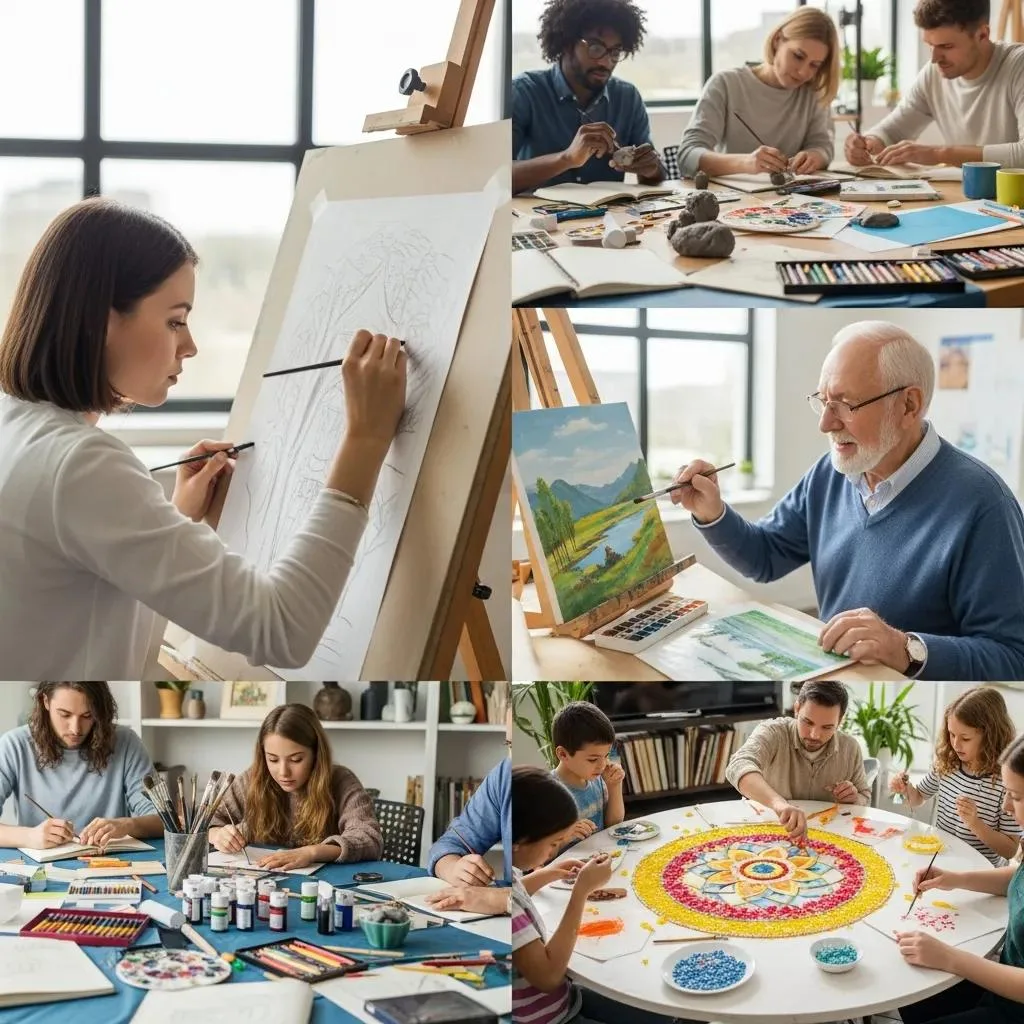
A wide array of techniques—drawing, painting, collage, sculpture, mandala creation, art journaling, and digital art—each afford distinct therapeutic pathways for expression, grounding, narrative work, and sensory regulation. Technique selection depends on clinical goals, developmental stage, and client preference; for example, clay is often chosen for grounding and somatic work while collage supports identity and narrative reconstruction. Below is a comparison table that links common materials and tools to primary therapeutic aims to guide choice in clinical or self-directed practice.
Matching the therapeutic aim to accessible materials supports practical uptake; next we explore how drawing, painting and collage specifically facilitate emotional release and include simple prompts.
How Do Drawing, Painting, and Collage Facilitate Emotional Release?
Drawing, painting, and collage each provide distinctive affordances: drawing offers immediacy and line-based expression; painting introduces color and scale to convey intensity; collage allows recombination of found images to build new narratives safely. Practical prompts stimulate emotional release—such as drawing “the shape of my worry,” painting a color landscape of mood, or creating a collage of desired strengths—which externalize internal states and create objects for reflection. In therapeutic settings, these media can be paired with short grounding rituals and reflective dialogue to translate visual content into verbal insight without forcing art into literal interpretation. These practices encourage experiential learning and provide visible progress markers that reinforce agency and coping.
What Role Does Mandala Creation and Art Journaling Play in Mindfulness?
Mandala creation and art journaling are structured approaches that reliably support mindfulness and self-monitoring through repetitive focus and reflective practice. Mandalas use symmetry and contained forms to center attention, reduce cognitive load, and activate parasympathetic responses, while art journaling combines imagery and words to track mood patterns and integrate therapeutic insights over time. A simple mandala exercise—center breath, draw concentric circles, color mindfully for 10–15 minutes—serves as a practical grounding routine. Art journaling prompts such as “draw a small image of how you felt today and write one sentence about it” foster ongoing awareness and create a record of change that supports therapeutic continuity and insight.
Who Can Benefit from Art Therapy: Target Populations and Conditions
Art therapy serves a broad range of populations, including children, adolescents, adults, seniors, trauma survivors, and individuals managing chronic illness or neurodiversity; its flexible formats—individual, group, or community programs—make it adaptable across settings. Core mechanisms vary by population: play-based visual methods suit developmental needs in children, narrative and identity-focused practices engage adolescents, and reminiscence-based projects support seniors with memory concerns. For chronic illness and medical settings, art therapy offers pain distraction, meaning-making, and identity adaptation that contribute to improved coping and quality of life. Understanding which populations benefit informs appropriate technique choice and referral pathways, which we unpack in the age-specific subsection.
How Does Art Therapy Help Children, Adolescents, Adults, and Seniors?
In children, art therapy often incorporates play and symbolic drawing to surface feelings and support developmental regulation through therapist-guided activities. Adolescents benefit from identity-centered projects—collage, zine-making, and narrative art—that externalize internal conflicts and foster autonomy within a therapeutic relationship. Adults typically engage in meaning-making, trauma processing, and skills-based regulation using expressive painting, journaling, or clay work. Seniors benefit from reminiscence art, structured memory prompts, and sensory-based activities that support cognitive stimulation and social engagement; these projects can mitigate isolation and provide accessible, dignity-preserving expression for those with memory impairment. Each age group requires adaptation of materials, pacing, and prompts to align with developmental and cognitive needs.
What Are the Applications of Art Therapy for Depression and Chronic Illness?
Art therapy addresses depression by activating behavioral engagement—encouraging small, achievable creative tasks that increase activity and mastery—and by facilitating meaning-making that counters helplessness. Group art therapy interventions also improve social connectedness and reduce isolation, which are key drivers of depressive symptoms. For chronic illness, art therapy provides channels for symptom expression, supports pain-coping through distraction and reframing, and assists identity adaptation when chronic conditions alter life roles. Programmatically, short series of art therapy sessions focusing on pacing, goal-setting, and graded creative tasks are effective adjuncts to medical care and psychological interventions for both mood and chronic health management.
How to Find Qualified Art Therapists and Access Art Therapy Resources
Finding qualified art therapists requires attention to credentials, verified training programs, and professional directories; informed searches prioritize practitioners with graduate-level clinical art therapy education and appropriate regional licensure or certification. When evaluating options, look for clinicians who articulate trauma-informed approaches, emphasize process over product, and can integrate art outcomes into a broader treatment plan. Below is a practical credential table to clarify common designations and where to verify them, followed by checklists and research resource guidance to help you locate training, continuing education, and current studies through 2024–2025.
After checking credentials, use professional associations and research databases to vet training programs and recent studies, and confirm clinicians’ approaches and experience with specific populations.
Use these search strategies when researching programs and studies:
- Search professional association directories for credential verification and practitioner listings.
- Look for graduate programs with accredited clinical placements and supervision models.
- Review recent journal literature (2024–2025) and university research centers for up-to-date evidence.
These steps help ensure safe, effective care and lead naturally to a short checklist for selecting a therapist.
- Checklist for finding an art therapist:
Ask about graduate training and supervised clinical hours.Confirm registry or licensure status appropriate to your region.Inquire about experience with your concern (trauma, pediatric, chronic illness).Request a brief initial consult to assess fit and therapeutic approach.
This checklist supports practical decision-making; the final table below summarizes tools and resources for training and research access.
- Practical tips for engaging art therapy:
Schedule a brief intake to discuss goals and safety considerations.Start with a short series (4–8 sessions) to assess fit and progress.Combine art therapy with other modalities when working with complex trauma or medical conditions. - Ways to access creative mental health care:
Explore community mental health centers and hospital-based programs that list art therapy on staff rosters.Ask mental health providers for referrals to credentialed art therapists.Consider teletherapy formats that incorporate digital art tools for remote access.